|
| The Karambit |
The Karambit is a remarkable utility knife that was born in the Indonesian archipelago with roots in Malaysia and the Philippines. Akin to the Swiss Army knife of today, this was the "pocket knife" of ancient villagers. This extraordinary little personal tool was first documented to be carried around the early 11th century AD and to this very day can be seen in various remote locations throughout the Indonesian islands, parts of Malaysia and the Southern Philippine islands.
Although rumored to have been brought to America around the late 1800's, the Karambit was "officially" introduced to the United States sometime in the late 1950's and made popular, especially with martial artists, through the late 1970's and 1980's. Virtually unknown in the secular community, by the mid-1990's it was predominantly recognized as a martial arts training element derived from the heritage of Indonesian Pencak Silat, Malaysian Pencak Silat and Filipino Kali.
 |
| Tiger claws |
Since before recorded time, different cultures around the globe developed different tools based on their needs. Some developed superior fishing tools, while others developed tools for planting crops. Tool design and application are a direct result of era and geography. A seaside dwelling tribe would develop different tools than would a mountainous or plains tribe. When various peoples migrated from one geographical location to another they brought with them their tools and way of life - sometimes peacefully, as in migration, and other times by war, as in the case of conquest.
According to my masters and the oral tradition that was passed down from master to student for centuries, prior to 1280 AD, most of West Java was part of the indigenous Pajajaran kingdom. The Badui tribe of West Java, the aboriginal people of Sunda, considered to be the ethnic group of the Pajajaran, lived relatively peacefully until the coming of the Majapahit empire (circa 1351 AD). At that time the Badui tribe quickly migrated to the rugged mountainous regions of the west, brought their weapons with them and remained self-governed.
The predominant uses of the Karambit in ancient times were similar to the uses of the European pocket knife: field work, including cutting twine or rope; chopping fruits and vegetables; and, in some rare cases, as an exceptional personal safety knife.
 |
| Karambit modern |
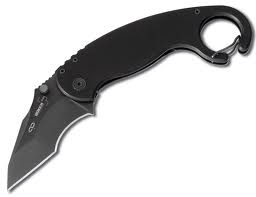
In modern times as the Karambit (now much smaller in size than its battlefield-sized ancestor) is now recognized internationally as a traditional weapon of Pencak Silat. Read more
When a fighter unsheathed a battlefield Karambit in ancient times, the cutting edge was almost always smeared with some type of deadly poison, which acted almost instantly upon entry into the bloodstream via laceration of the flesh. Even the smallest cut was enough to usher the poison into the bloodstream. Knowledge and use of poisons derived from various species of poisonous frogs, snakes, scorpions and spiders were considered an essential element of a warrior's arsenal of close-quarter combative skills. These poisons rapidly accelerated death and were mostly feared for their nearly instantaneous killing power.
As a martial-arts implement, it is an extraordinary ancient artifact that permits the accomplished practitioner grace, style and freedom of creative movement. Very much akin to dance-like movements, the true art of the Karambit is like ballet.
The personal Karambit (smaller version of the battlefield Karambit) was primarily designed for targeting the nerves and joints. As a result of such a small cutting surface, most cuts cannot be made deep enough to kill someone. That is why the Karambit can be considered a personal self-defense tool. In contrast, the blade of the Karambit Besar (larger or battlefield version of the personal-sized Karambit) is longer and thus permits deeper cuts. According to the ancients, the battlefield Karambit was preferred not only for its superior length but for the fact that you could, as a result of the lengthy cutting edge, "spill the entrails of your enemies onto the ground." However, as it was in the West, with the advent of battle-worthy and functional firearms, bladed weapons became obsolete on the battlefield and relegated to the utilitarian uses of knives that we see today.
Specifically designed as a close-quarter self-defense weapon, the Karambit of old was additionally quite difficult to see in the hand due to its method of deployment and cover of the fingers. Doubly menacing was that it could not be disarmed as a result of its forefinger-grip design. It was unique to any other blade at the time as it could be used for both a medium and close fighting ranges without changing distance of the striking arm. It was also the only blade used in battle that could cut twice with a single arm stroke. All other blades of that era need one motion for one cut. The ancient battlefield Karambit was unique because:
It could not be easily seen.
It could not be easily disarmed
It could change ranges without body movement
It could deliver two strikes in a single arm motion.